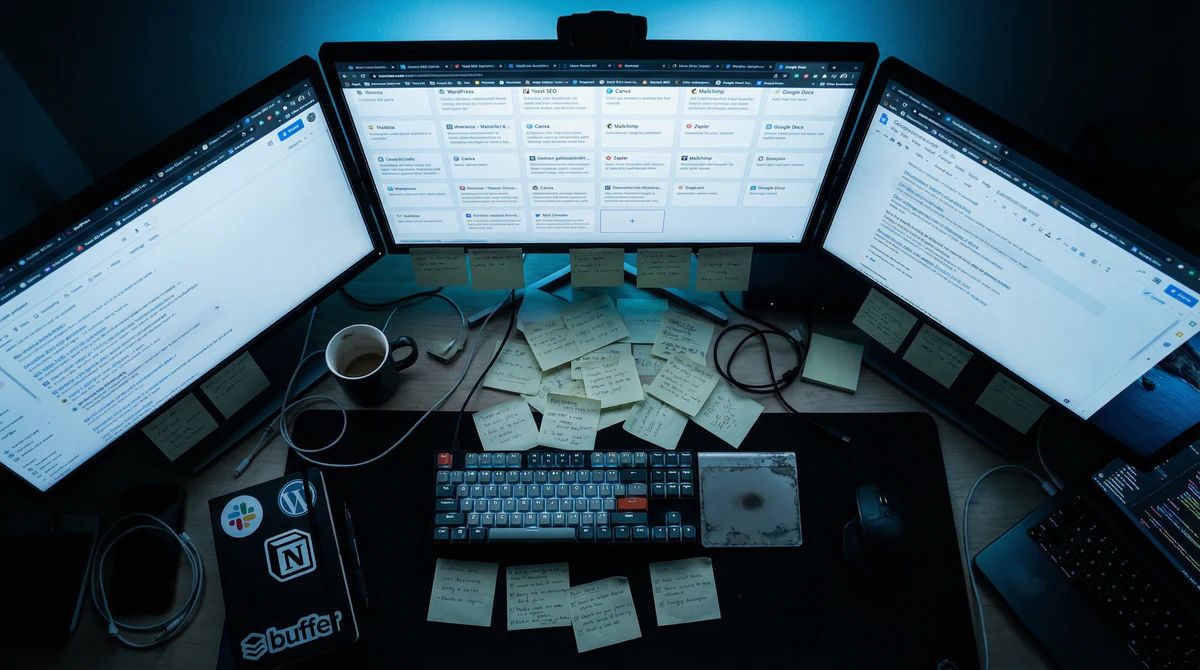
I want you to do something right now. Open a new tab and count how many tools touch your content between "idea" and "published."
Go ahead. I'll wait.
If you're like most teams I talk to, it's somewhere between five and nine. A CMS. An SEO plugin. A separate image tool. Something for social scheduling. Maybe a newsletter platform. A Zapier glue layer holding it all together with prayers and duct tape.
Each one costs $15-50/month. None of them talk to each other properly. And every single one of them has a settings page you haven't looked at since 2023.
But here's the thing — the subscription fees aren't what's killing you. They're a rounding error. The real cost is everything you can't see on an invoice.
The tax you're paying every single time you publish
Let's talk about what actually happens when someone on your team publishes a blog post.
They write the draft. Then they copy it into the CMS, reformatting half of it because the editor butchered their markdown. They open Yoast or whatever SEO plugin they're running, stare at a stoplight system designed for 2016-era keyword stuffing, and half-heartedly adjust a meta description. They open Canva or Midjourney to make a hero image, spend 20 minutes getting something passable, download it, re-upload it, crop it for the CMS, then crop it again differently for social. They schedule a tweet — wait, do they even have access to the social account? They Slack someone who does. That person gets to it two days later. The post is already buried.
Newsletter? That's a whole separate workflow. Someone copies the intro into Mailchimp, fights with the template builder, sends a test, realizes the links are wrong, fixes them, sends another test. Maybe it goes out that week. Maybe it doesn't.
I'm not exaggerating. I've watched this exact sequence play out at companies doing $10M+ in revenue. Smart people, burning hours on logistics instead of the thing that actually moves the needle: the writing itself.
The hidden costs nobody budgets for
Context switching is a performance destroyer. Every time your content person alt-tabs between tools, they lose focus. Research from UC Irvine puts the recovery time at 23 minutes per interruption. If publishing a single post requires touching six different tools, that's not a workflow — it's a series of interruptions wearing a trench coat.
Plugin maintenance is a full-time job nobody signed up for. WordPress plugins break. They conflict with each other. They push updates that change default settings. They get abandoned by developers who moved on to their next SaaS idea. I've seen sites go down because a plugin auto-updated and nuked the permalink structure. Nobody noticed for three days.
SEO as an afterthought is barely SEO at all. When optimization is a separate step bolted onto the end of your process, it gets skipped when people are busy. And people are always busy. The difference between SEO that's baked into the publishing flow and SEO that's a checklist someone runs after the fact is the difference between ranking and not.
Distribution isn't a separate department. If your blog post goes live and then someone has to manually push it to Twitter, LinkedIn, and your newsletter — that's not distribution, that's data entry. Half the time it doesn't happen. The other half, it happens three days late when nobody cares anymore.
Multi-site management is where it really falls apart. Running content across multiple domains? Now multiply every problem above by however many sites you manage. Different WordPress installs, different plugin versions, different themes with different image requirements. It's entropy with a login page.
What it actually looks like when publishing isn't painful
I'm going to describe something, and I want you to notice your emotional reaction to it.
You write your post. In the same interface, you set your target keywords and the SEO optimization happens as you write — not after. You generate a hero image right there, already sized correctly for your site and social cards. You set your tweet text and newsletter excerpt. You hit publish. The post goes live, the tweet gets scheduled, the newsletter segment gets queued. If you manage multiple sites, you pick which ones from a dropdown.
One interface. One publish action. Everything handled.
Your reaction to reading that was probably something between "that sounds nice" and "yeah right." I get it. I had the same reaction, which is why I built it.
The math that made me snap
Here's the napkin math that pushed me over the edge.
A content person spending 45 minutes per post on logistics instead of writing. Publishing three posts a week. That's over two hours a week — roughly 110 hours a year — spent on tool juggling. At even a conservative $50/hour fully loaded cost, that's $5,500/year in wasted labor. Per person.
Meanwhile, the actual tool subscriptions everyone fixates on? Maybe $200/month total. $2,400/year.
You're spending more than double on the friction than on the tools creating the friction. And that's before you count the posts that never got distributed, the SEO that never got done, and the newsletter that went out late (or didn't go out at all).
So what do you do about it
You have two options.
Option one: keep optimizing your current stack. Add another Zapier zap. Write better SOPs. Hope your team follows them. Accept that publishing will always feel like assembling IKEA furniture without the instructions.
Option two: consolidate.
I built BlackOps Center because I got tired of option one. It's a content operating system — not another plugin, not another point solution. CMS, SEO, AI image generation, social scheduling, newsletter integration, multi-site management. One platform. One workflow. One publish button that actually does what "publish" should mean.
There's a 14-day free trial. No credit card. No sales call. Just try it and see if your publishing workflow stops feeling like a second job.
Or don't. Keep counting your tools in that other tab.
Ben Newton builds tools for people who publish. He's been shipping content infrastructure since before "content ops" was a LinkedIn buzzword.
Related Posts
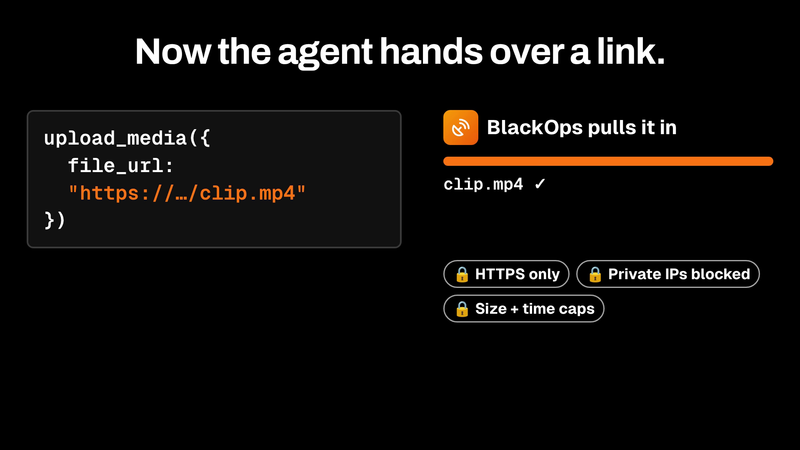
upload_media now pulls files in by URL
upload_media now takes a file_url. BlackOps fetches the file server-side behind SSRF guards and returns an asset ID that attaches straight to a tweet or post.

I kept forgetting my newsletter. Now BlackOps sends it and tells my readers why.
Set a schedule. If you miss it, BlackOps writes the issue from what you published, tells your readers it's covering for you, and sends it. Your own send always wins.

Your Obsidian Daily Notes Can Finally Talk Back
You've been creating Obsidian daily notes for years. Now BlackOps writes them on your schedule, connects them to your calendar and brains, and lets you talk to them from any AI chat.