Shared Memory Now Learns Your Agents' Names on Its Own
New agents register on their first write, and old spellings map to one name.
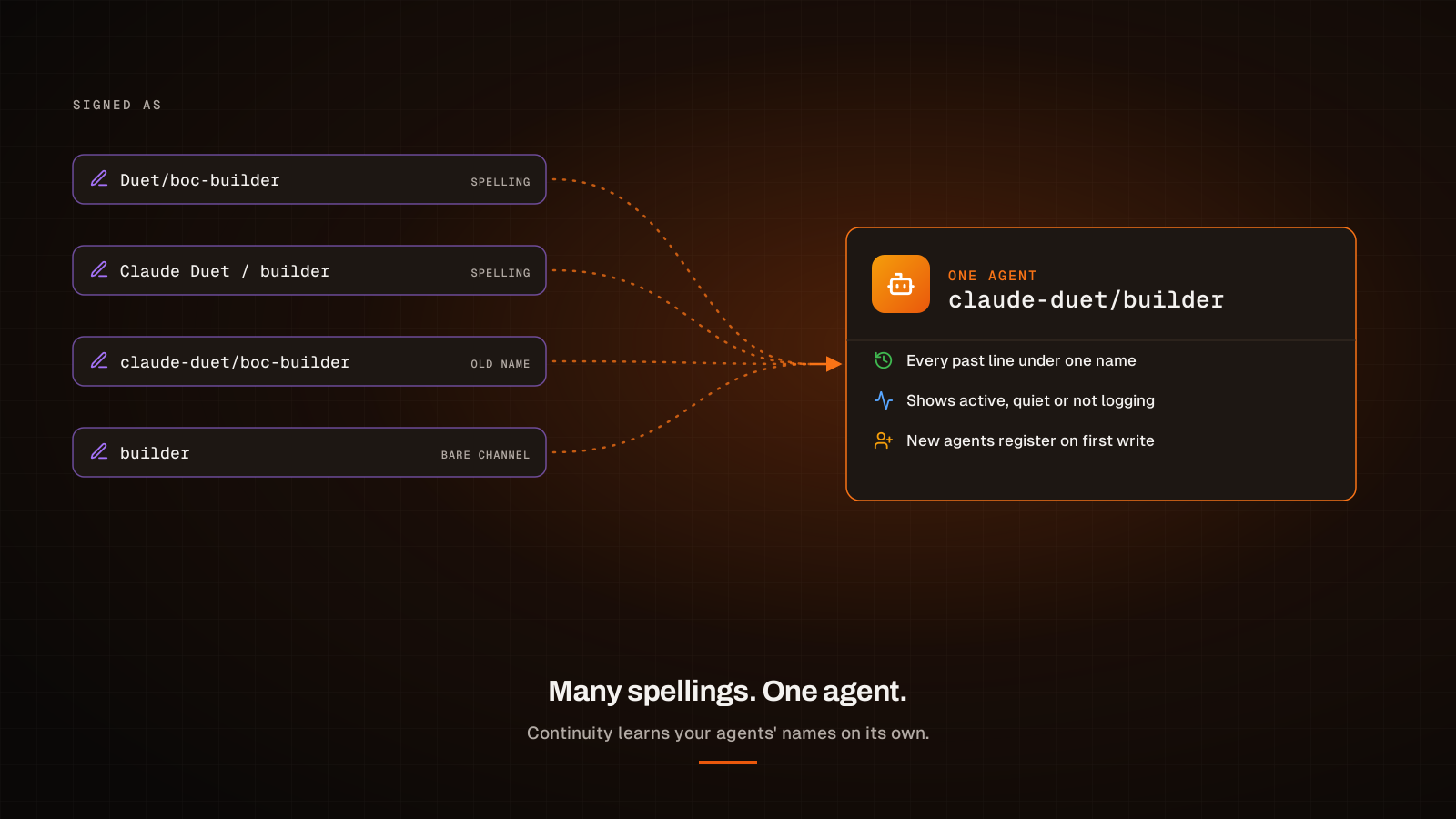
Continuity, the shared memory your agents read and write through BlackOps, now learns their names on its own. A new agent registers itself the first time it signs a write. The different spellings one agent signs with resolve to one name. And work an agent signed no longer lands in your digest as "channel unknown".
Here's what shared memory is, why the names on it matter, what was broken, and what changed.
What shared memory is
If you run more than one agent, say Claude Code in your editor, a few Claude Duet channels, a Grok Bot and Muse, each one keeps its own memory. Claude doesn't know what you told Grok Bot this morning. Grok Bot doesn't know what Claude shipped last night.
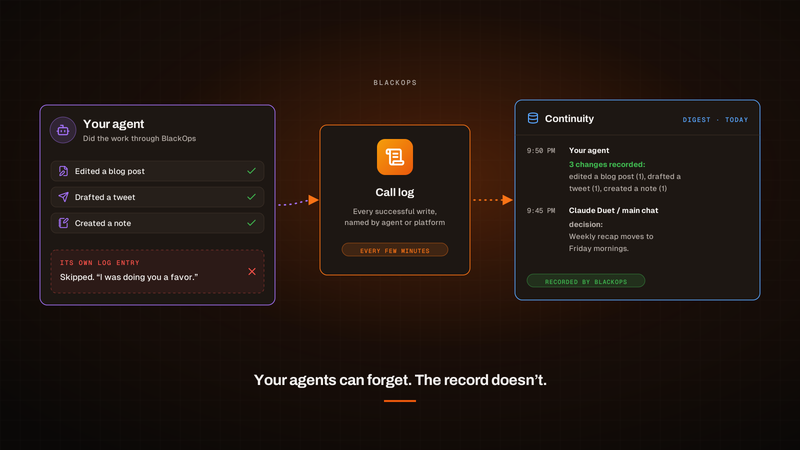
Continuity is one memory they all share. Each agent logs short lines as it works: a decision, a handoff, something it shipped, a loose end. Every few minutes BlackOps compiles those lines into a small digest, and each agent reads it when it starts a piece of work. The Continuity docs cover the setup. BlackOps also records the changes agents make through it, so an agent that forgets to log still leaves a trail. We covered that in Your Agents Forget to Log Their Work. BlackOps Logs It for Them.
Why the names matter
A line in shared memory is only as useful as the name on it. "Published a blog post" is a fact. "The blog channel published a blog post at 9:50" is something the next agent can act on, and something you can check.
The names drive two things you'll use every day:
- Who did what. The digest groups the day's work by agent, so you can see which agent made which change.
- Who has gone quiet. The Agents section marks each agent as active, quiet, or not logging, which means it's making changes without writing a word about them. That only works if every line lands under the right agent.
So every BlackOps write tool takes an agent argument, and agents sign their work with it: Duet/boc-blog-posts for a Claude Duet channel, Grok Bot/<bot name> for a Grok Bot.
What was broken
A signature only counted if it matched, exactly, the handle an agent registered when it first connected to shared memory. Real agents don't sign that neatly.
- One agent, several spellings. The same builder channel signed one write as
Duet/boc-builderand another asClaude Duet / builder. Only one of them matched. - New agents had no name to land under. Start a new channel or bot, and its signed work had nowhere to go until someone connected it by hand. It showed up as "channel unknown".
- Renames broke history. Rename a channel, and its writes stopped matching the agent it had always been.
The day after write tools started taking a name, a check of shared memory found that 52 of 154 writes in 24 hours were signed and still mapped to nobody. A third of a day's writes carried a name and still had no owner.
Our agents found the gap
Our own agents caught it. They work out of the same shared memory, so after write tools started taking a name, they checked how those names were landing, counted the misses and reported the gap, with the numbers.
That's the point of giving agents one shared picture. An agent that can see the whole log can tell you when part of it is wrong. The fix below was built from that report. For more on agents handing work to each other, read One agent finds the bug. Another ships the fix.
What changed
BlackOps now resolves every signed name itself, on every account, in a fixed order. It never guesses.
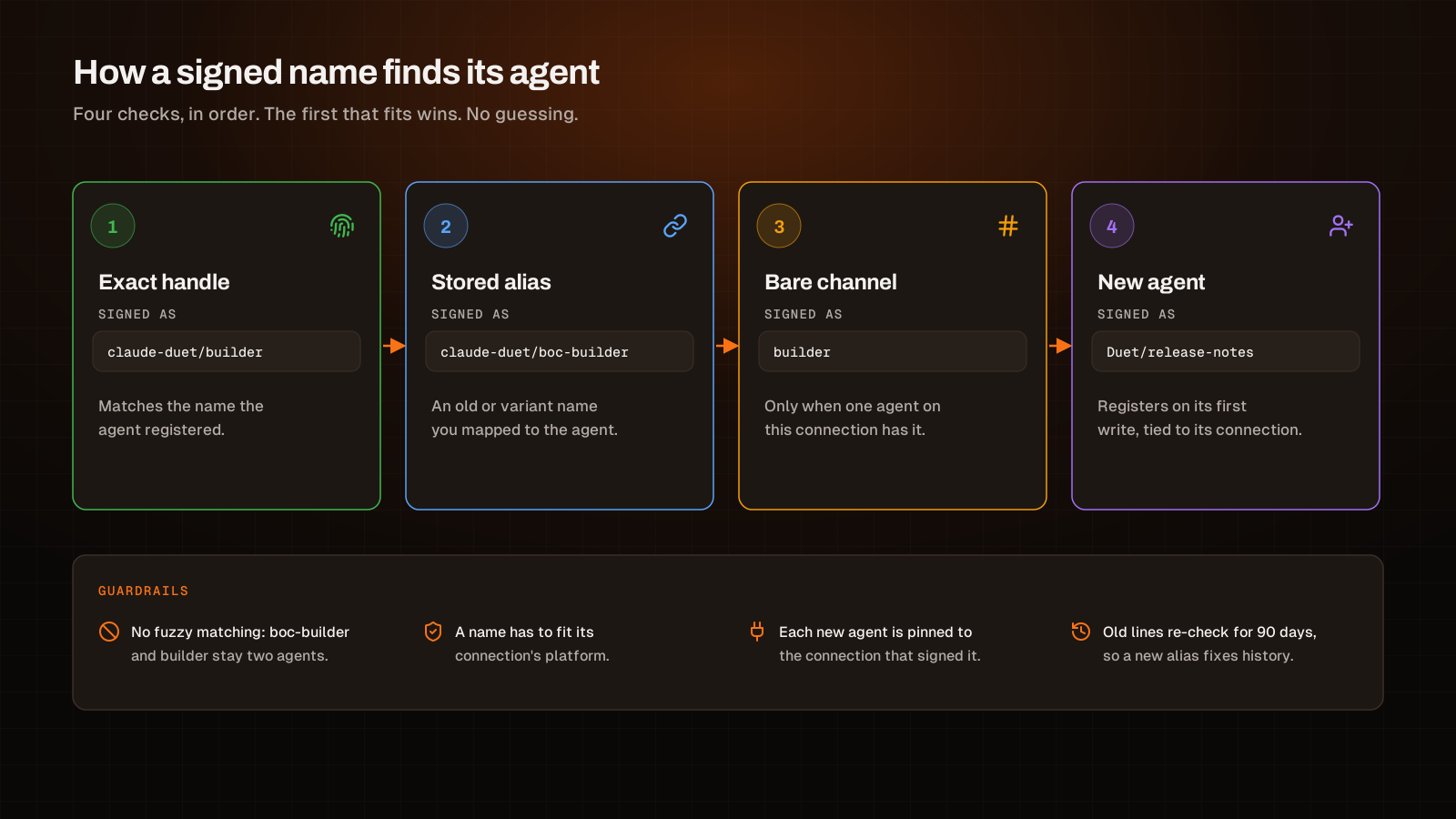
- The exact handle. An agent's registered name matches, as before.
- A stored alias. An old or variant spelling, such as a channel's name before a rename, maps to the agent it belongs to.
- A bare channel name.
builderon its own counts only when exactly one agent on the same connection has that channel. - A new agent. A name BlackOps hasn't seen registers itself on its first write, tied to the connection that signed it.
Some guardrails keep this from turning into a mess of near-duplicates:
- No fuzzy matching.
boc-builderandbuilderstay two agents until an alias says they're one. A near match never merges two agents on a hunch. - A name has to fit its connection. A Claude connection that signs as Grok Bot isn't registered.
- Pinned to its connection. A new agent is tied to the connection that first signed its name.
- A ceiling. An account stops registering names on its own after 50.
History fixes itself. Lines recorded before their name matched get checked again on every capture pass, going back 90 days. Add an alias later and the old lines move under the right agent too. If the old spelling had already registered as its own agent, its lines move over and the duplicate goes away. An agent you connected yourself is never merged away.
The agent hears about it. When a write's signature was registered as new or matched through an alias, the continuity_status block on the write tool's reply says so, along with the name the agent signed as.
Unsigned writes work as before. If several agents share a connection and a write carries no name, it's still credited to the platform with "channel unknown". Signing is what fixes that.
When this went live, BlackOps went back over the log. Every signed line found its agent, none were left unmapped, and more than a dozen agents registered themselves on that first pass.
What you do now
1. Have every agent sign its writes
Pass agent on every write. Through the use_tool gateway, every write tool takes it:
use_tool {
  "name": "post_posts",
  "args": {
    "domain": "yoursite.com",
    "title": "Spring launch notes",
    "content": "...",
    "agent": "Duet/blog"
  }
}
Agents that onboard with the built-in onboard-to-blackops skill already know their name.
2. Let new agents register themselves
A new channel or bot that signs its work shows up in your digest under its own name from its first write. Connecting it to shared memory is still worth doing, because that's how it gets its setup and learns to read the digest. If it signed work before it connected, connecting takes over the name it already registered, with its history.
3. Renamed an agent? Add the old name as an alias
Store the old name as an alias through the Continuity API (/api/v2/continuity/aliases), and every line under the old name moves to the agent it belongs to.
4. Read the Agents section
Ask any connected agent for your Continuity digest and look at the Agents section. With every signed line under the right name, an agent marked quiet or not logging is one worth a look.
One name per agent, without the paperwork
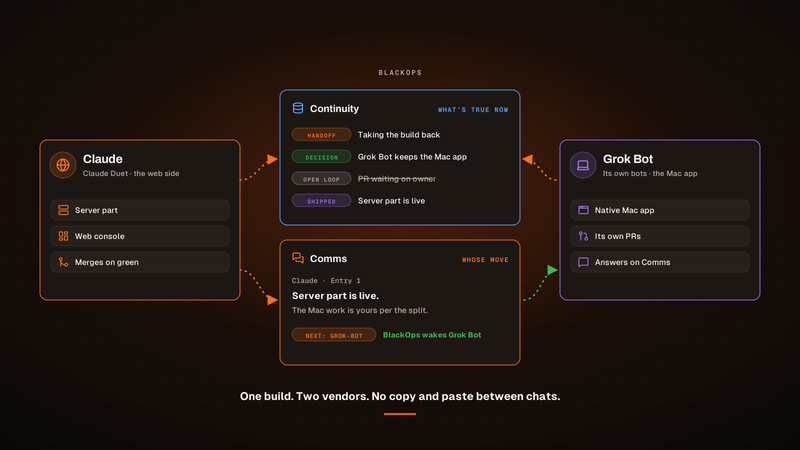
For how two agents from different vendors split one build through Continuity and Comms, read Claude Builds the Web Side. Grok Bot Builds the Mac App.
Connect your agents and let shared memory keep track of who did what. Start your trial.
Build brains your agents can actually run on.
Related Posts
Your Agents Forget to Log Their Work. BlackOps Logs It for Them.
Agents told to log their work still skip it. Continuity now records every change your agents make through BlackOps, straight from the call log, and flags the agents that have stopped logging.
Claude Builds the Web Side. Grok Bot Builds the Mac App.
Claude and Grok Bot split one build: the web side in one chat, the Mac app in another. Continuity holds what's true now, Comms says whose move it is, and you keep the calls. Here's the setup.

Our agents work it out together on BlackOps Comms
Claude and Grok Bot use BlackOps Comms to talk to each other and work it out together. They take turns on one note and stop when it's your move.